Consultation methodology and response
1.16 Each chapter in this report provides detailed information about the consultation methods from which feedback has been reported; the following section provides a brief overview.
1.17 To provide relevant information that might inform respondents’ views, information about the options for the nine services was included in a consultation document and supporting documentation including in summary and Easy Read format. After being encouraged to familiarise themselves with the background information, residents, staff, and other stakeholders were invited to provide feedback through a wide range of methods, including all of the following:
- a consultation questionnaire that was available online (hosted by ORS) and via paper copies, which were circulated widely and available on request. Alternate language and Easy Read formats were also provided.
- engagement activities undertaken by Hywel Dda, including:
- online webinars and face-to-face public drop-in events
- staff drop-in events, hospital walkarounds and meetings
- meetings with statutory and non-statutory stakeholders/partners
- attendance at and visits to existing community groups, outpatient settings, and public events like the Royal Welsh Show and Pembrokeshire County Show.
- residents’ workshops, independently designed and facilitated by ORS.
- written, email, and telephone submissions.
- social media.
1.18 The response from the different consultation methods is summarised below.
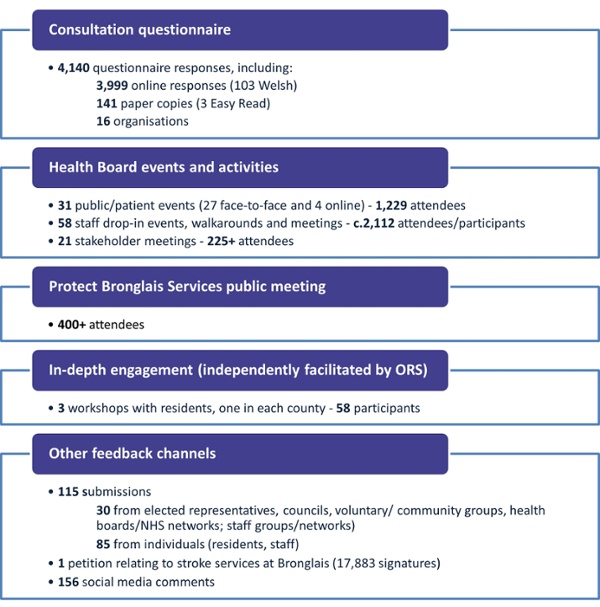
Note on the consultation questionnaire
1.19 While more than 4,000 respondents provided a response to the consultation questionnaire, none of the questions were mandatory and many respondents did not answer every question. All responses in which at least one of the consultation questions was answered were included. It should also be noted that while open questionnaires are important in being inclusive and giving opportunity to express and explain their views, they are not controlled, random sample surveys of a given population, and therefore are not necessarily expected to be representative of the overall general balance of opinion.
1.20 103 questionnaire responses were received in Welsh, the text comments from which were translated by one of ORS’s Welsh-speaking researchers, and quality assured by ORS’s Welsh-speaking senior researcher2. Responses were integrated with the English responses in readiness for analysis.
1.21 Further details can be found in the consultation overview (chapter 2).
2 The same process was undertaken for the one Welsh-language written submission received.