Stroke consultation document

24/7 – 24 hours a day, seven days a week.
Acute care – Hospital care for the first few hours/days of an illness for people who are seriously unwell. Focuses on urgent tests, treatment, and stabilisation.
Acute Stroke Unit – A place in a hospital where acute care is provided by a stroke specialist team.
Allied Health Professionals (AHPs) - work in a variety of health and social care environments, including hospitals, community clinics, GP practices, people’s homes, and private enterprises. They deliver strong, practical, solution-focused, and life-affirming outcomes through a unique range of physical, psychological and social interventions. AHPs play a vital role in ensuring people receive comprehensive, personalised and effective care.
In Wales there are 13 professions included under the term ‘Allied Health Professionals’. Examples include physiotherapists, occupational therapists, speech and language therapists and dietitians.
Comprehensive Regional Stroke Centre (CRSC) – An Acute Stroke Unit that can provide thrombectomy treatments. These provide care for patients over a larger geographical region and are described in the quality statement for stroke.
CT scan – A CT (computerised topography) scan uses x-rays and a computer to create detailed images of the inside of the body. A CT angiogram (CTA) is a CT scan that looks at blood vessels in the brain.
Diagnostics – Tests or procedures used to identify a person’s disease or condition.
Early Supported Discharge (ESD) – This service is for some stroke patients, usually for people who have a mild-to-moderate disability. It enables home-based stroke rehabilitation through a specialist multidisciplinary team. It provides responsive (within 24 hours) and intensive stroke rehabilitation in the patient’s place of residence over a fixed, time-limited period (e.g. six weeks).
Integrated Community Stroke Service (ICSS) – This service provides early effective community rehabilitation to all stroke patients leaving hospital. The team works with the patient and their family, the acute stroke unit staff, and other support services including the voluntary sector to ensure the earliest possible discharge of the patient.
Patient outcomes – The results of a patient’s care and treatment. Patient outcomes can include things like whether someone survives, how quickly they recover, how independent they are afterwards, and their quality of life.
Pre-hospital video triage – An assessment made by an ambulance team, with the support of a video call with the specialist stroke team, to help take a patient to the correct care environment, as quickly as possible.
Quality Statement for Stroke – A Welsh Government document that describes what stroke services should look like and do. This was revised in February 2026.
Rehabilitation – Providing ongoing therapy and support during and after the acute phase of a stroke to help patients recover and regain independence. This is usually in a dedicated stroke rehabilitation unit or as part of Early Supported Discharge in the community.
Sentinel Stroke National Audit Programme (SSNAP) – A national clinical audit for stroke care in the UK. It collects detailed information on the care people receive following a stroke, from hospital admission through rehabilitation and discharge.
Stroke – A stroke is a serious life-threatening medical condition that happens when the blood supply to part of the brain is cut off. This causes parts of the brain to become damaged or die due to a lack of oxygen.
Stroke specialist team or service – A stroke specialist team or service is a group of specialists who work together regularly to manage patients who have had a stroke. Between them, they have the specific knowledge and skills to assess and manage stroke-related problems.
Stroke Rehabilitation Unit – A place in a hospital where rehabilitation care is provided by a multidisciplinary stroke rehabilitation team.
Thrombectomy – A thrombectomy is a medical procedure designed to remove a thrombus (blood clot) from a blood vessel, which can be either an artery or a vein. Only certain patients are suitable for a thrombectomy, this is dependent on the type of stroke and when it happened.
Thrombolysis – A medical procedure injecting medicine into the body that can break up a clot in an artery or vein and restore blood to the brain.
Transient ischemic attack (TIA) – A TIA is an illness that can produce stroke-like symptoms.
Treat and transfer – Patients receive their initial stroke assessment and treatment at the nearest appropriate hospital. They are then transferred to an acute stroke unit for further care or Thrombectomy Centre in Cardiff or Bristol if this is the most appropriate treatment.
Welsh Ambulance Services University NHS Trust (WAST) – The organisation responsible for responding to emergencies in the community and bringing patients to hospital.
Thank you for your continued interest in our Clinical Services Plan. This document is about the second phase of our consultation. It focuses on how stroke services could be provided across our four main hospital sites in Hywel Dda University Health Board (Hywel Dda).
We are now asking for your views on the preferred option for stroke services. This preferred option was discussed at our Public Board meeting on 18 and 19 February 2026.
In that meeting, our Board agreed future service models for eight of the nine services included in our Clinical Services Plan. You can read more about the Clinical Services Plan on our website here (opens in new tab).
For stroke, the Board asked for further work and additional engagement on a preferred option with communities before a final decision can be taken.
The new preferred option has been developed by bringing together elements of two alternative ideas suggested during the first phase of consultation (Option 106 and Option 210). Together, these would create:
- a 24-hour acute stroke and rehabilitation unit at Glangwili Hospital
- a stroke rehabilitation unit at Bronglais Hospital, and
- treat and transfer for stroke provided from Bronglais, Prince Philip and Withybush hospitals. Following initial treatment patients would be transferred from here to Glangwili Hospital or directly to a thrombectomy centre (in Cardiff or Bristol) if this is the most appropriate treatment
The Board felt that by bringing these two alternative options together we could better address the challenges facing the service and strengthen the future delivery of high-quality stroke care. However, it is also recognised that we must work through the detail carefully to understand what this could mean for patients, carers, staff, partner organisations, and our wider communities.
The Board agreed that a final decision on stroke services could not be made until:
- work was undertaken to develop and assess the new option to the same level of detail as the other options considered at the Public Board meeting, and
- this second phase of consultation has taken place, so we can understand the views on this new preferred option
After this, our Board will consider all of the evidence and everything it has heard during both phases of the Clinical Services Plan consultation. It will then make a final decision on the future service model for stroke at Hywel Dda.
For all our communities, we must improve the standards of care we provide and the outcomes our patients experience. We do not believe that the current way we are delivering stroke care is giving the best outcomes for patients. We also need to address ongoing staffing challenges that make it difficult to deliver the high-quality service our population deserves.
Thank you to everyone who has contributed their time and feedback to help us get to this point. No decisions about the future model for stroke services have yet been made. We want to hear from you - our staff, patients, wider communities, organisations we work with, and people with an interest in health and wellbeing in our area.
Please tell us what you think about the preferred option and how it might affect you by completing our questionnaire by 26 July 2026. Thank you.
Dr Neil Wooding
Chair
Professor Philip Kloer
Chief Executive
Mr Mark Henwood
Executive Medical Director
Hywel Dda University Health Board (Hywel Dda) is your local NHS organisation.
We plan, organise, and provide health services for almost 400,000 people in Carmarthenshire, Ceredigion, and Pembrokeshire. Some of our services are also used by communities in bordering areas of south Gwynedd, and parts of Powys and Swansea/Neath Port Talbot.
Our communities are quite spread out, often in rural areas.
We provide services through:
- four main hospitals (Bronglais Hospital in Aberystwyth, Glangwili Hospital in Carmarthen, Prince Philip Hospital in Llanelli, and Withybush Hospital in Haverfordwest)
- five community hospitals (Amman Valley Hospital and Llandovery Hospital in Carmarthenshire, Tregaron Hospital in Ceredigion, Tenby Hospital and South Pembrokeshire Hospital in Pembrokeshire)
- two integrated care centres (Aberaeron and Cardigan, both in Ceredigion)
- community facilities, including GP surgeries, dental practices, community pharmacies, ophthalmic (eye care) practices and sites providing mental health and learning disability services care within your own homes
Highly specialised services can be provided outside our area, for example, in Swansea, Cardiff, or even outside Wales such as in Bristol.
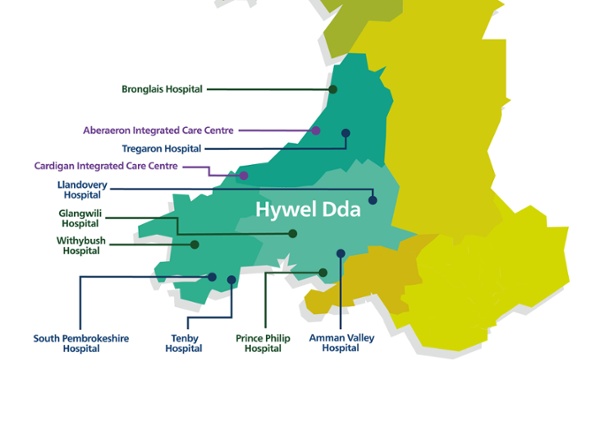 A map of the hospitals in Hywel Dda
This second phase of the Clinical Services Plan consultation is specifically about how we could deliver stroke services in the future.
A stroke is a serious life-threatening medical condition that happens when the blood supply to part of the brain is cut off.
Who we want to talk with
We really appreciate you taking the time to share your thoughts – thank you. This second phase of the consultation is for all members of the public who live, work, or have an interest in our area.
We recognise people have different interests and perspectives. You may receive our services, or care for someone who does.
You may work with us as staff, students, or volunteers. You may represent an organisation potentially affected by our proposals or you may have an interest in health and wellbeing.
As well as speaking to people in our area, we will also continue to work with health boards in neighbouring counties and encourage residents or organisations in these areas to share their views also.
We want you to tell us
- whether you support the preferred option and why
- if you don’t support the preferred option, whether a previously considered option by Board would work better and why
- anything else you think we need to consider to make stroke services work better in the future. This includes any mitigations or improvements, and potential Welsh Language impacts if the service operates differently in the future
The following points are decided and not open to influence in this second phase of the consultation:
- The future roles of our four main hospital sites and the future service models for the other eight services included in the Clinical Services Plan consultation:
- critical care,
- dermatology,
- emergency general surgery,
- endoscopy,
- ophthalmology,
- orthopaedics,
- radiology, and
- urology
- We are not accepting alternative new ideas for how stroke services could be delivered in Hywel Dda. These were received during the first phase of consultation
- The overall direction of our strategy ‘A Healthier Mid and West Wales: Healthier lives, well lived’:
- moving towards a wellness service rather than an illness service
- developing a social model for health
- supporting people, through technology and other means, to stay healthy, independent, and in their own homes
- significant capital investment to improve or replace old buildings
- bringing together acute hospital services to make them stronger and improve standards of care
In March 2023, our Board approved a programme approach to develop a clinical services plan in response to service fragilities. This was based on the principles of care that are safe, sustainable, accessible, and kind.
The development of a clinical services plan was to provide a set of plans for nine clinical services that were considered to be the most fragile.
These included:
- critical care
- dermatology
- emergency general surgery
- endoscopy
- ophthalmology
- orthopaedics
- radiology
- stroke
- urology
It was necessary to look at change in these nine services as there are risks to those services being able to continue to offer safe, quality services or timely care.
We have recognised for several years that some of our hospital services are fragile. This is mainly because our clinical teams are spread across multiple sites, with an over-reliance on a small number of staff.
For all services we looked at the factors affecting each service. This included considering any temporary changes, clinical guidelines and policies, staffing issues and cost challenges.
Given the challenges, we developed the Clinical Services Plan with options to change these nine clinical services. Any option developed needed to be delivered within four years from any decision. Our Board also considered what further changes could be made in more than four years.
We involved members of staff and public, identifying people and organisations (stakeholders) who should be part of the conversation. More information is available in our Clinical Services Plan Consultation Document, available on our website here (opens in new tab).
As a result of our consultation, an independent report was prepared by Opinion Research Services (ORS), also available on our consultation web pages. The report summarises more than 4,000 questionnaire responses, in addition to feedback shared at public, staff and stakeholder events attended by over 4,000 people.
At its extraordinary meeting, held over two days in February 2026, our Board carefully considered the independent consultation report alongside a range of other information. This included the latest information on workforce and service resilience, estate condition, operational pressures, regional working, new clinical standards and how services link to each other.
The Board also considered the 22 alternative options for all nine services that were suggested as part of the consultation process and met the hurdle criteria.
Hurdle criteria are the essential conditions an alternative idea needed to meet before it progressed for further consideration as an option presented to the Board.
All draft options, and any new ideas that may be suggested in this consultation, should meet the following criteria:
- Clinically sustainable – Does the option allow for progress towards delivering quality standards? Does it consider any co-dependencies? Will the workforce be able to deliver it?
- Deliverable – Is the option clinically and operationally deliverable within the timeframe of two to four years? Are there capital or building requirements that can be secured and delivered in that timeframe?
- Accessible – Does the option provide access for people within an appropriate timeframe? Does the option support a reduction in waiting times for patients? Is there equity in access?
- Strategically aligned – Does the option support the direction set out in the ‘A Healthier Mid and West Wales - Healthier lives, well lived’ strategy, or at least not contradict it? Does the option support joint prevention work to improve population health, or at least not contradict it?
- Financially sustainable – Does the option support effective use of our finances?
Our Board also identified services where further engagement or additional information is required to understand the impacts of options before final decisions can be made. Consideration was given to the practical steps needed for implementation, including how changes would need to be phased over time.
For the implementation phase, final decisions were reached for all services except stroke. More information about the decisions made for the other eight services included in our Clinical Services Plan is available on our website here (opens in new tab).
For stroke, a new merged idea was explored. It combined elements from two alternative options to progress towards a 24-hour acute stroke unit in Glangwili Hospital and a stroke rehabilitation unit in Bronglais Hospital.
Due to the scale of change, our Board identified that further assessment and engagement was required with staff, communities, and stakeholders before any decisions could be made for the future model of stroke services across Hywel Dda.
A stroke is a serious life-threatening medical condition that happens when the blood supply to part of the brain is cut-off by a blood clot or bleeding from a blood vessel. Strokes are a medical emergency and urgent treatment is essential. The sooner a person receives treatment for a stroke, the better their chance of recovery. Stroke strikes suddenly and can result in a devastating range of disabilities or death, having a profound impact on individuals and their families.
Stroke units are where you should be sent to within four hours of hospital admission for your initial care.
Our stroke clinical teams are spread across our stroke units on our four main hospital sites. This means our teams, which are small, are spread over a large geographical area.
Stroke services are currently provided at:
- Ystwyth Ward in Bronglais Hospital
- Gwenllian Ward in Glangwili Hospital
- Ward 9 in Prince Philip Hospital, and
- Ward 11 in Withybush Hospital
In 2023-2024 there were 792 stroke admissions across all our hospitals, this is approximately 16 per week. Approximately 30% of strokes were treated at Glangwili and Withybush hospitals and approximately 20% of strokes were treated at Bronglais and Prince Philip hospitals.
More serious strokes are transferred to thrombectomy centres, such as in Cardiff or Bristol.
Suspected stroke patients come into our care in several ways. This includes by:
- ambulance following a 999 call
- patients directly arriving via walk-in services
- suspected stroke being identified amongst current inpatients, or
- suspected stroke being identified in the community by a healthcare professional
Patients need a CT (computerised tomography) and/or CTA (computerised tomography angiography) scan in some cases. This is to identify if they have bleeding around the brain or if there is a blockage or closing of a blood vessel.
The initial assessment of suspected stroke patients is carried out by trained medical staff. An important part of the initial treatment for some stroke patients is thrombolysis. This is a treatment where a drug is given to a patient to break down blood clots and try to reestablish the blood supply to the brain. It is important for the thrombolysis treatment to be given as early as possible. The best outcomes are achieved for those patients who receive thrombolysis within three hours, although it can be given effectively after this up to four and half hours.
After admission to a stroke unit, patients are reviewed by a consultant. Once well enough, patients then receive multidisciplinary assessments, as well as intensive rehabilitation, as appropriate. Patients are discharged home in accordance with the severity of their stroke. The pace of their recovery can also be helped by Integrated Community Stroke Services. Integrated Community Stroke Services are being gradually developed in Hywel Dda to support stroke patients in the community, allowing for earlier discharge from hospital.
Wales follows national best practice for stroke care, guided by the UK National Stroke Programme to improve prevention, treatment, and recovery.
All health boards and trusts in Wales are expected to adopt the Quality Statement for Stroke as a framework for planning and delivering optimal stroke prevention and care in collaboration with their partners. This has been developed by the Welsh Government in alignment with the commitments outlined in ‘A Healthier Wales’.
NHS Wales has developed its own standards for stroke care, designed specifically for the needs of people in Wales. These standards are built on the National Clinical Framework, ensuring that care is consistent, high quality and evidence based. They are reinforced by the Quality Statement for Stroke, which sets out what excellent patient centred stroke care should look like across Wales. Together, these standards support a population health approach, helping to improve outcomes for people, families, and communities across the country.
A clear pathway is outlined for stroke
- Stroke prevention
- Transient Ischaemic Attack (TIA)
- Pre-hospital stroke care
- Acute phase 0-72 hours
- Recovery and rehabilitation
- Integrated Community Stroke Services
- Life after stroke
Currently, our stroke services do not meet clinical standards, and we do not have seven-day specialist cover. This can lead to patient outcomes that are not as good as they could be. This is why we need to change the way stroke services are delivered so they are safe, sustainable, accessible and kind for patients and staff.
The Quality Statement for Stroke sets out what high quality, person-centred stroke care should look like across Wales. It provides a framework for health boards to plan and deliver consistent, safe, and modern stroke services.
Currently, our stroke service resources are spread thinly across multiple sites.
This means:
- we have inadequate staffing levels in nursing, allied health professionals, and specialist stroke consultants
- we rely on single-handed locum consultants at Bronglais and Glangwili hospitals that makes our service fragile
- we do not have seven-day specialist cover
- our population do not have access to a specialised Comprehensive Regional Stroke Centre (CRSC) within our area
- we have not been able to meet the evidence-based standards recommended by the Royal College of Physicians and measured by the Sentinel Stroke National Audit Programme (SSNAP)
- we have an over-reliance on individuals and a risk of service collapse, this means our services are not resilient
- we do not have a community rehabilitation service that meets the stroke standards for Integrated Community Stroke Services
- we do not have a seven-day (or five-day) transient ischemic attack (TIA) service as recommended by the stroke standards
- unequal participation in research studies due to staffing shortages
This suggests that our population is not getting the best possible outcomes following a stroke, which means avoidable deaths and disability. It also shows that, although our staff work incredibly hard to provide the best care they can, the nearest hospital for patients may not be able to support a patient throughout their whole care and treatment or offer the best outcomes.
We recognise that the specialism of stroke services and the development of specialist Comprehensive Regional Stroke Centres (CRSCs) may mean some patients receive their ongoing care in a different hospital to the one they are currently familiar with. For families and carers, this could mean travelling further to visit loved ones who are in hospital. We understand the impact this can have, and it is something we take seriously as part of our decision-making.
There were two options that we originally consulted on as part of our Clinical Services Plan. These were Option A and Option B.
Option A included treat and transfer units in Bronglais and Glangwili hospitals, and stroke units (specialist cover 12-hours a day) in Prince Philip and Withybush hospitals.
Option B included treat and transfer units in Bronglais and Glangwili hospitals, a stroke unit (specialist cover 24-hours a day) in Prince Philip Hospital and a treat and transfer and stroke unit (specialist cover 12-hours a day) in Withybush Hospital. In this option patients at Withybush Hospital would be transferred to Prince Philip Hospital for their initial care before returning to Withybush Hospital for further care and stroke rehabilitation.
In both options, Bronglais and Glangwili hospitals would become treat and transfer hospitals for stroke.
In Option B, Withybush Hospital would also become a 'treat and transfer' hospital for stroke. This would mean following initial assessment, stroke patients requiring acute care would be transferred elsewhere within Hywel Dda (differs between our options, as outlined above) or to a thrombectomy centre, such as in Cardiff or Bristol, according to their needs. Care for TIAs (mini stroke) would continue at Bronglais, Prince Philip and Withybush hospitals, but not Glangwili Hospital.
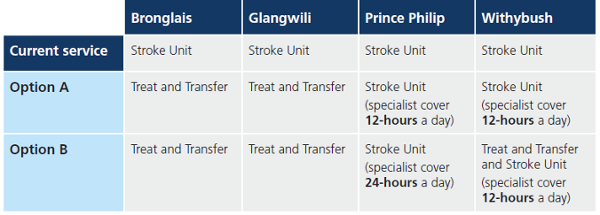 Stroke options we consulted on
National clinical guidelines for stroke have changed with a four-and-a-half-hour window for thrombolysis from the onset of stroke where suitable.
Where appropriate, thrombolysis drugs should be given within 45 minutes of arrival at the hospital, although they are licensed for use within four and a half hours of the onset of a stroke.
Following the consultation process, 28 unique alternative options were received for stroke services that did not meet hurdle criteria. In summary, these alternative ideas were:
- 12-hour specialist cover stroke units at Bronglais and Withybush hospitals, with treat and transfer services at Glangwili and Prince Philip hospitals
- 12-hour specialist cover stroke units at Bronglais and Prince Philip hospitals, with treat and transfer services at Glangwili and Withybush hospitals
- 12-hour specialist cover stroke units at Bronglais and Glangwili hospitals, with treat and transfer services at Prince Philip and Withybush hospitals
- 12-hour specialist cover stroke units at Glangwili, Prince Philip and Withybush hospitals, with treat and transfer services at Bronglais Hospital
- 12-hour specialist cover stroke units at Bronglais, Glangwili and Withybush hospitals, with treat and transfer services at Prince Philip Hospital
- 12-hour specialist cover stroke units at Prince Philip and Withybush hospitals, with Bronglais Hospital supported as a third site with telemedicine
- 12-hour specialist cover stroke units at Bronglais, Prince Philip and Withybush hospitals with treat and transfer services at Glangwili Hospital
- 24-hour specialist cover stroke unit at Prince Philip Hospital and a 12-hour specialist cover stroke unit at Bronglais Hospital, with treat and transfer services at Bronglais, Glangwili and Withybush hospitals
- 24-hour specialist cover stroke unit at Glangwili Hospital, a 12-hour specialist cover stroke unit at Withybush Hospital, with treat and transfer services at Bronglais, Prince Philip and Withybush hospitals
- 24-hour specialist cover stroke unit at Glangwili Hospital and 12-hour specialist cover stroke units following treat and transfer at Bronglais, Prince Philip and Withybush hospitals
- 24-hour specialist cover stroke units at Bronglais and Glangwili hospitals, with treat and transfer services at Prince Philip and Withybush hospitals
- 24-hour specialist cover stroke units at Bronglais and Withybush hospitals, with treat and transfer services at Glangwili and Prince Philip hospitals
- 24-hour specialist cover stroke units at Bronglais and Prince Philip hospitals, with treat and transfer services at Glangwili and Withybush hospitals
- 24-hour specialist cover stroke unit at Withybush Hospital and 12-hour specialist cover stroke units after treat and transfer at Bronglais, Glangwili and Prince Philip hospitals
- 24-hour specialist cover stroke unit at Bronglais Hospital and 12-hour specialist cover stroke units after treat and transfer at Glangwili, Prince Philip and Withybush hospitals
- 24-hour specialist cover stroke unit at Glangwili Hospital and 12-hour specialist cover stroke units after treat and transfer at Bronglais and Withybush hospitals, with a stroke rehabilitation unit after treat and transfer at Prince Philip Hospital
- 24-hour specialist cover stroke units at Bronglais, Glangwili and Withybush hospitals, with treat and transfer services at Prince Philip Hospital
- 24-hour specialist cover stroke unit at Prince Philip Hospital and 12-hour specialist cover stroke units after treat and transfer at Bronglais, Glangwili and Withybush hospitals
- 24-hour specialist cover stroke unit at Prince Philip Hospital, a 12-hour specialist cover stroke unit at Withybush Hospital, a 12-hour specialist cover stroke unit with telemedicine at Bronglais Hospital, with treat and transfer services at Bronglais, Glangwili and Withybush hospitals
- 24-hour specialist cover stroke unit at Prince Philip Hospital, a 12-hour specialist cover stroke unit at Withybush Hospital and a stroke therapy rehabilitation unit at Bronglais Hospital, with treat and transfer services at Bronglais, Glangwili and Withybush hospitals
- 24-hour specialist cover stroke unit in Glangwili Hospital, treat and transfer and consultant therapist rehabilitation units provided at Bronglais, Prince Philip and Withybush hospitals
- 24-hour specialist cover stroke units at Bronglais, Glangwili, Prince Philip and Withybush hospitals
- A Comprehensive Regional Stroke Centre in Swansea Bay University Health Board and Bronglais, Glangwili, Prince Philip and Withybush hospitals providing stroke units and rehabilitation after treat and transfer
- A Comprehensive Regional Stroke Centre in Swansea Bay University Health Board only
- A Comprehensive Regional Stroke Centre at Glangwili Hospital, a consultant therapy led unit in Prince Philip Hospital and treat and transfer services at Bronglais, Prince Philip and Withybush hospitals
- A Comprehensive Regional Stroke Centre at Swansea Bay University Health Board with consultant therapy led unit in Prince Philip Hospital, with treat and transfer at Bronglais, Glangwili, Prince Philip and Withybush hospitals
There were two alternative options that did meet hurdle criteria and were considered by Board.
The current stroke service provided by Hywel Dda is stroke units at Bronglais, Glangwili, Prince Phillip and Withybush hospitals.
Option 106 - was based on Option A and included treat and transfer units in Bronglais and Glangwili hospitals, and stroke units (specialist cover 12-hours a day) in Prince Philip and Withybush hospitals.
In this option, patients at Bronglais Hospital would be transferred to Prince Philip Hospital for their initial care before returning to Bronglais Hospital for further stroke rehabilitation.
Option 210 - was based on Option B but using different sites. It included treat and transfer units in Prince Philip and Withybush hospitals, a stroke unit (specialist cover 24-hours a day) in Glangwili Hospital and a treat and transfer and stroke unit (specialist cover 12-hours a day) in Bronglais Hospital.
Patients at Bronglais Hospital would be transferred to Glangwili Hospital for their initial care before returning to Bronglais Hospital for further care and stroke rehabilitation.
In all the options considered by our Board:
- the ambulance would take a suspected stroke patient to their nearest main hospital
- the initial assessment scan (typically a CT scan), as well as initial treatment (i.e. thrombolysis) would be delivered at the receiving hospital as is the case now
- more serious strokes would be transferred to thrombectomy centres, such as in Cardiff or Bristol, as they are now
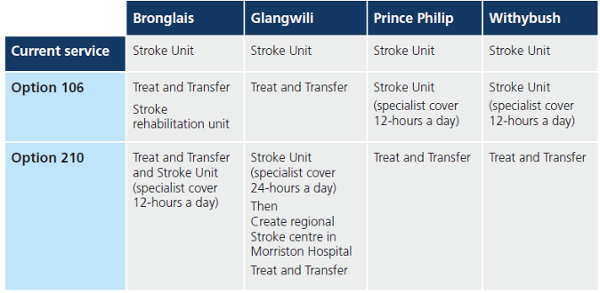 The two alternative options
After the consultation closed, and before any decisions were made, the Board carried out a conscientious consideration process. This means carefully looking at and thinking through all the feedback people shared, alongside the evidence, before moving towards any decision.
When reviewing consultation responses, as well as new data, guidance and information about stroke services, it became clear that no single option on its own fully addressed the challenges facing the service. However, some parts of different options that had already been assessed were seen as having strengths that could work better if they were brought together.
Because of this, the Board discussed a new merged idea, combining elements of options 106 and 210 that were suggested through the consultation. It was described as an idea, not a final option, because it had not yet been tested or considered in the same way as the consulted and alternative options shared with the Board.
The Board then agreed to take this merged idea forward as a preferred option for further testing and engagement.
While recognising that Option 106 could provide services across more locations, it was felt that maintaining services at three main hospitals would not address staffing sustainability challenges.
While Option 210 addressed challenges around accessing stroke care for people in Ceredigion, parts of Powys and south Gwynedd, it was felt that it wouldn’t be sustainable to maintain an acute stroke unit in Bronglais hospital.
The merged idea (options 106 and 210) proposes a more sustainable approach for Bronglais Hospital. This would provide a stroke rehabilitation unit, while still bringing together acute stroke care services at a single site. This would also help address some of the concerns raised, especially by those living in Ceredigion, Powys and south Gwynedd, about travel times for patients and visitors.
The Board identified that this approach could strengthen the stroke service. It would bring staff together onto fewer sites and extend specialist provision beyond the current weekday model to deliver better patient care and outcomes. Our Board recognised that progressing with a preferred option could bring opportunities to design innovative, creative rehabilitation models offering new staff roles.
This second phase of the consultation is an opportunity to understand the impacts of the idea, hear people’s views, and test whether it could work in practice before any final decision is made.
With CT perfusion imaging, which is a medical scan that shows how blood flows through body tissues the thrombolysis time can be extended up to nine hours from the onset of a stroke and can extend the thrombectomy treatment window.
The current stroke service provided by Hywel Dda is stroke units at Bronglais, Glangwili, Prince Phillip and Withybush hospitals.
Under the preferred option – there would be a stroke unit at Glangwili Hospital with 24-hour specialist cover, seven days a week. Bronglais, Prince Philip and Withybush hospitals would become treat and transfer hospitals. Stroke patients would be transferred to Glangwili Hospital from these hospitals for their acute stroke care. Bronglais Hospital would also have a stroke rehabilitation unit, meaning patients closest to this hospital would be transferred back to Bronglais Hospital from Glangwili Hospital for their stroke specific rehabilitation.
As part of the preferred option, we talk about working regionally in the longer term. This would mean working more closely with other Health Boards in Wales. How this will look has not yet been decided. It could mean more patients from neighbouring Health Boards receive their stroke care in Hywel Dda or that more patients in Hywel Dda receive their stroke care in a neighbouring health board.
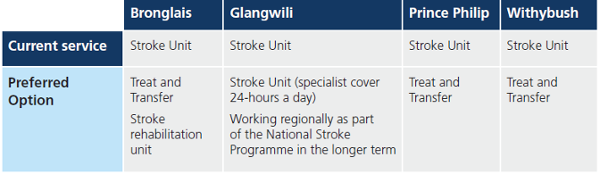 The preferred option for stroke
Under this option, patients with a suspected stroke would receive emergency stroke assessment and initial treatment as quickly as possible, usually at their nearest hospital. This may include a CT scan and or CT perfusion imaging leading to potential thrombolysis, where clinically suitable, following initial scans and assessment.
If, after the initial assessments, a patient needs further stroke specialist care, they would be transferred to the 24-hour acute stroke unit at Glangwili Hospital or the thrombectomy centres in Cardiff or Bristol, according to their needs.
Glangwili Hospital would provide 24-hour specialist stroke cover and rehabilitation to treat patients during their hyper-acute phase (which typically covers the first 72 hours) and acute phase (typically between three and 10 days).
After this time, some patients would be well enough to return home, with the support of the Integrated Community Stroke Service (ICSS). Patients still needing further specialist stroke treatment and support in hospital, would receive this at Glangwili Hospital if they live in the south of Hywel Dda area. Patients living closer to Bronglais Hospital would receive their rehabilitation treatment in Bronglais.
Opportunity to improve standards of stroke care
This preferred option reduces the fragility of the stroke service and raises standards by bringing together the staff across fewer sites.
It allows further consolidation of specialist staff than some of the other options previously considered by the Board. It brings together acute stroke specialist care (beyond initial treatment) for stroke patients within the Hywel Dda area at one hospital site.
This preferred option reduces the fragility of the stroke service further because it provides 24-hours of specialist cover, seven days a week. This would allow for a more intensive first 72 hours of care and improved patient outcomes.
This option would focus specialist stroke therapy on two sites, Bronglais and Glangwili hospitals, rather than across four sites. This would help with staffing challenges and potentially be more attractive to future staff, as well as improve clinical standards and patient outcomes.
This would specifically help us to meet the standards by:
- ensuring we have the right staffing levels in our acute stroke unit and stroke rehabilitation unit
- ensuring that we have sustainable staff rotas so that we can offer services seven days a week
- enabling us to meet more SSNAP measures by having access to staff and services
- creating community rehabilitation capacity with Integrated Community Stroke Services which are aligned to standards
- increasing access to TIA clinics in line with stroke standards
- sustained support to education, training and research opportunities for all stroke trainees
The quality statement for stroke services sets out a vision for how stroke services should be provided in Wales. Part of this includes bringing together stroke specialists in fewer hospitals to create Comprehensive Regional Stroke Centres (CRSCs). These are 24-hour, seven day a week centres that support the highest level of care for the first 72 hours, including thrombolysis, thrombectomy, diagnosis, monitoring and rehabilitation. Currently there are no CRSCs in Wales, and the national programme for stroke is looking at how we can plan and deliver these in the future.
In our preferred option we talk about regional working. This could be:
- one of our hospitals hosting elements of a CRSC, as it is unlikely we would be able to develop all of the services a CRSC can provide (such as thrombectomy), or
- working with another health board in the region who provide parts of these services for our patients
We understand that, with the preferred option, more patient transfers would be needed than there are currently. Under this option, stroke patients nearest to Bronglais, Prince Philip and Withybush hospitals would all access their specialist stroke care in Glangwili Hospital.
Under the preferred option, of the 16 stroke patients admitted per week on average, 11 of these patients would be transferred to Glangwili Hospital from a treat and transfer hospital site. Two patients a week would be transferred back to Bronglais Hospital for rehabilitation in the stroke rehabilitation unit or discharged to their community for onward care or their home.
During the consultation, we heard that people were concerned about being moved after initial assessment. We recognise this can be worrying. We already do this for some stroke patients who need to travel to Cardiff or Bristol for thrombectomy, and we have established processes in place to support safe transfers when they are needed.
We also heard that people were concerned that they would be too unwell to be transported and experience harm while moving between hospitals. Patients who are too unwell to travel will stay where they are until it is safe to transfer them for their acute stroke care.
Getting patients to hospital and between hospital sites, is partly within our control. However, travel for staff commuting, patients accessing care, and visitors travelling to see patients is largely outside our control. To ensure that the benefits of the preferred option are fully realised, appropriate transport solutions will be essential.
Patients who need to be transferred between hospital sites would be supported through a new transfer arrangement and not existing community ambulance provision provided by Welsh Ambulance Services University NHS Trust. Further work is needed to understand how this would be delivered.
During the first and second phases of the Clinical Services Plan consultation, we have considered travel times for urgent transfers between hospitals (see table below). In this preferred option for stroke, we considered average travel times in each county alongside feedback from staff and patient transport surveys.
A travel survey was carried out in 2023, at 9am on a Monday morning, the travel times are provided between hospital sites. Two timings are provided for each journey: one for non-urgent travel, and one for travel using lights and sirens.
- Travelling from Bronglais Aberystwyth to Glangwili Carmarthen for non-urgent journeys takes one hour and 25 minutes, with lights and sirens it takes one hour and four minutes.
- Travelling from Bronglais Aberystwyth to Withybush Haverfordwest for non-urgent journeys takes one hour and 51 minutes, with lights and sirens it takes one hour and 25 minutes.
- Travelling from Bronglais Aberystwyth to Prince Phillip Llanelli for non-urgent journeys takes one hour and 50 minutes, with lights and sirens it takes one hour and 29 minutes.
- Travelling from Bronglais Aberystwyth to Royal Shrewsbury Shrewsbury for non-urgent journeys takes one hour and 55 minutes, with lights and sirens it takes one hour and 32 minutes.
- Travelling from Bronglais Aberystwyth to Princess Royal Telford for non-urgent journeys takes two hours and 17 minutes for lights and sirens it takes one hour and 52 minutes.
- Travelling from Bronglais Aberystwyth to Ysbyty Gwynedd for non-urgent journeys takes two hours and 12 minutes for lights and sirens it takes one hour and 53 minutes.
- Travelling from Bronglais Aberystwyth to Morriston for non-urgent journeys takes one hour and 49 minutes, with lights and sirens it takes one hour and 30 minutes.
- Travelling from Withybush Haverfordwest to Gangwili Carmarthen for non-urgent journeys takes 42 minutes, with lights and sirens it takes 38 minutes.
- Travelling from Withybush Haverfordwest to Prince Phillip Llanelli for non-urgent journeys takes one hour 7 minutes, with lights and sirens it takes 58 minutes.
- Travelling from Withybush Haverfordwest to Morriston Swansea for non-urgent journeys takes one hour 6 minutes, with lights and sirens it takes 59 minutes.
- Travelling from Glangwili Carmarthen to Prince Phillip Llanelli for non-urgent journeys takes 34 minutes, with lights and sirens it takes 27 minutes.
- Travelling from Glangwili Carmarthen to Morriston Swansea for non-urgent journeys takes 34 minutes, with lights and sirens it takes 28 minutes.
- Travelling from Prince Phillip Llanelli to Morriston Swansea for non-urgent journeys takes 18 minutes, with lights and sirens it takes 14 minutes.
You can read about how we used data from 2023-2025 to understand how many patients could be transferred between site in the ‘Patient and travel insights’ document available in the ‘Supporting Documents’ area of our webpages (opens in new tab).
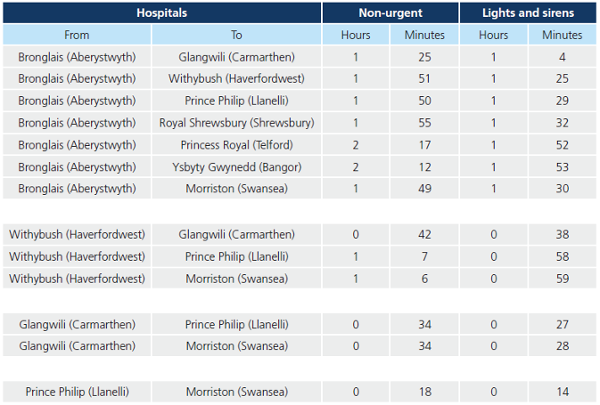 Table of transfer times between hospitals
Throughout the consultation, we’ve considered how changes to stroke services could impact on travel and transport for you, your loved ones who may visit you in hospital, and our staff.
Under the preferred option, acute stroke care is delivered further away from home for some patients, and this would have an impact for families and carers.
Delays in ambulance availability, bad weather, or long journey times can affect patient safety. People who live in rural or more remote parts of the Hywel Dda area and neighbouring communities may have longer travel and transfer times to access stroke services. We recognise this is a concern. In the preferred option, some patients and families would need to travel further, but patients would receive specialist care in a single 24-hour acute stroke unit, which we expect to provide safer, higher-quality care than we can currently deliver across four sites.
This preferred option would rely on strong coordination between emergency departments, stroke teams, ambulance services, imaging, rehabilitation teams and Integrated Community Stroke Services across several sites. Any breakdown in communication could affect patient outcomes. We will need to continue working with Welsh Ambulance Service Trust, local authorities and transport providers to reduce these barriers. We will also need to review our own policies on how we can reduce the impact of any change on people who may face socio-economic barriers to accessing care.
The option will not be delivered until agreed transfer plans are in place to meet the needs of the local population. When deciding to engage further on this preferred option, the Board noted that a robust emergency transfer process needs to be in place and that the option is dependent on this.
Online platforms would also need to be provided to keep families connected and we would aim to get people home sooner with community service support.
We provide examples of what travel impacts could be experienced by people in our Teulu Jones case studies document (available in the Supporting Documents area on our website).
Bringing together teams across a smaller number of sites, along with more investment in the service, would help us better meet national stroke standards. This includes improving access to the best rehabilitation spaces and helps us to increase the amount of time our patients receive specialist stroke therapy. Increased therapy leads to much better outcomes.
At present, achieving these standards is challenging due to staffing shortages. This relates particularly to specialist allied health professionals, including occupational therapists, physiotherapists, speech and language therapists, and dietitians across acute and community stroke services.
To deliver this option, the change will take place over a longer period of time than the other options previously considered by Board. The development of a standalone unit will require space in Glangwili Hospital and capital investment. This will mean that services will move to Glangwili Hospital from other hospitals more gradually over time.
This will be achieved by bringing parts of stroke units from other sites to Glangwili Hospital over first four years, while the development of community services will also take place in this time.
Prince Philip Hospital would become a treat and transfer and stroke rehabilitation unit within two years. Bronglais Hospital would become a treat and transfer and stroke rehabilitation unit in two to four years. The staffing would be increased over this time to deliver higher quality of care for patients. In the longer term (more than four years) a 24-hour specialist cover acute stroke unit in Glangwili Hospital with rehabilitation would be in place. Prince Philip and Withybush hospitals would become treat and transfer hospitals only, at this point.
We believe that this option could be fully delivered in up to eight years, the option could be delivered in less than eight years if space and workforce become available.
For further information on how the preferred option could be delivered, please visit the ‘Supporting Documents’ area of our website.
The costs for delivering this option would be similar to those that were considered for Option 210. Staffing costs would increase by approximately £3.259m in this option. Building and equipment costs would be approximately £19.845m to develop a standalone unit.
The preferred option aligns to the future roles of our hospitals and our strategy ‘A Healthier Mid and West Wales: Healthier lives, well lived’.
In the longer term, the intention is that the acute stroke unit could move into the new urgent and planned care hospital, once it is built. This would maintain stroke care alongside other urgent services on one site and support a more sustainable 24/7 specialist service.
In addition, it aligns with the NHS Wales Stroke Programme’s intention to have fewer, more specialised, stroke units in Wales.
This option would enable the stroke service in Hywel Dda to participate in more stroke research and new projects. By having a greater number of stroke patients in the same unit, and staff who are focused solely on stroke work, there are more opportunities to carry out research projects. This is something under the current service model isn’t always possible. Research is important, as it helps further the understanding and treatment of stroke.
Having fewer acute stroke units in hospitals allows us to move and create more roles in the community to support rehabilitation.
We have a family - Teulu Jones - and friends who help us test and show how different health services could affect someone like you or your loved ones. They aren’t a real family, but they have been designed to be typical of the patients we care for in the Hywel Dda area and surrounding communities.
Here you can read how care for stroke patients could look under the preferred option, based on your nearest Hywel Dda main hospital site:
- Bronglais Hospital
- Glangwili Hospital
- Prince Philip Hospital
- Withybush Hospital
Since the publication of the Clinical Services Plan Consultation document in May 2025, some clinical pathways have developed. The current pathway described below in our Teulu Jones case studies differs to what was in the previous consultation document.
Aziz is 68 years old and he works in the family restaurant and enjoys looking after his grandchildren. His wife notices he is not himself one afternoon, one side of his face has dropped, and his speech is slurred. She is worried he might have had a stroke and calls 999. To show the different options for stroke, we will imagine Aziz lives in Aberystwyth.
Under the preferred option…
An ambulance takes Aziz to Bronglais Hospital, and he is taken directly to the CT scanner, rather than to the Emergency Department. If a stroke is confirmed, thrombolysis treatment would be started whilst in the scanning department. Aziz would then be moved to the Emergency Department before he is transferred.
If Aziz hasn’t had a stroke, he will go to the Emergency Department at Bronglais Hospital for further tests.
If Aziz had a more serious stroke (with a large blood vessel occlusion, which is a type of stroke where blood flow to a main artery in the brain is interrupted), he would be taken by ambulance from Bronglais Hospital directly to the thrombectomy centre in Bristol or Cardiff. Thrombectomy can be used to treat these types of stroke. This care is provided regionally for Wales and south and western regions of England in Bristol and Cardiff.
Once Bristol or Cardiff thrombectomy team assess Aziz as fit to be discharged from their care, he will be transferred back to the stroke unit at Glangwili Hospital or directly home, dependent on recovery post-thrombectomy. If thrombectomy is not the right treatment for Aziz, then he will be transferred to the Stroke Unit at Glangwili Hospital for his acute stroke treatment.
Following his acute stroke treatment at Glangwili Hospital, if Aziz is considered medically stable, he will transfer back to Bronglais Hospital rehabilitation unit to receive care closer to home or be discharged home with support from the Integrated Community Stroke Service.
Sonia, 37, is married with two sons, and manages her own part-time business. She is always on the go and busy. Sonia has high blood pressure. We will imagine Sonia lives in Pembroke Dock.
Whilst visiting a friend, Sonia complains of a blinding headache, begins to have issues with her vision and speech problems. Her friend calls an ambulance as she is worried Sonia has suffered a stroke. What would the preferred option look like for her care?
Under the preferred option…
An ambulance takes Sonia to Withybush Hospital, and she is taken directly to the Emergency Department for assessment, followed by transfer for a CT scan.
If a stroke was confirmed, treatment would be started whilst in the scanning department. Sonia would be returned to the Emergency Department before being transferred to the Stroke Unit in Glangwili Hospital.
If Sonia hasn’t had a stroke, she will go back to Emergency Department at Withybush Hospital for further tests. If Sonia had a more serious stroke (with a large blood vessel occlusion, which is a type of stroke where blood flow to a main artery in the brain is interrupted), she would be taken by ambulance from Withybush Hospital directly to the thrombectomy centre in Bristol or Cardiff. Thrombectomy can be used to treat these types of stroke. This care is provided regionally for Wales and south and western regions of England in Bristol and Cardiff.
Once Bristol or Cardiff thrombectomy team assess Sonia is fit to be discharged from their care she will be transferred to Glangwili Hospital or directly home dependent on recovery post thrombectomy. If thrombectomy is not the right treatment for Sonia, then she will be transferred to the Stroke Unit at Glangwili Hospital for her acute stroke treatment and rehabilitation.
Sonia may be able to be discharged home with support from the Integrated Community Stroke Service.
Rhys is 52 years old and a long-distance lorry driver. He is overweight and whilst his diet is improved at home, he often resorts to fast food when on the road. Rhys lives in Newcastle Emlyn, in Carmarthenshire, close to the Ceredigion border.
He becomes ill with a terrible headache and feels dizzy. His speech is slurred and his wife suspects a stroke and calls 999 immediately.
Under the preferred option…
An ambulance takes Rhys to Glangwili Hospital, and he is taken directly to the CT scanner within the stroke unit. Following the scan, Rhys would remain in the stroke unit. If a stroke is confirmed and Rhys needs thrombolysis treatment, this will take place in the Stroke Unit at Glangwili Hospital.
If Rhys hasn’t had a stroke, he will go to Emergency Department at Glangwili Hospital for further tests.
If Rhys had a more serious stroke (with a large blood vessel occlusion, which is a type of stroke where blood flow to a main artery in the brain is interrupted), he would be taken by ambulance to the thrombectomy centre in Bristol or Cardiff. Thrombectomy can be used to treat these types of stroke. This care is provided regionally for Wales and south and western regions of England in Bristol and Cardiff.
Once Bristol or Cardiff thrombectomy team assess Rhys is fit to be discharged from their care he will be transferred back to Glangwili Hospital or directly home dependent on recovery post thrombectomy.
If thrombectomy is not the right treatment for Rhys, then he will stay at the Stroke Unit at Glangwili Hospital for his acute stroke treatment. Rhys may be able to be discharged home with support from the Integrated Community Stroke Service.
Alun is a retired electrician. His passion is rugby and at 80 years old he enjoys a daily walk and the crossword. He has a history of heart disease and had a heart attack when he was 70. Alun lives in Llanelli.
His daughter arrives for a visit and Alun has a numb arm, slurred speech and difficulty in understanding what she is saying to him. Alun’s daughter calls 999.
Under the preferred option ...
An ambulance takes Alun to Prince Philip Hospital, and he is taken directly to the Acute Medical Assessment Unit for an assessment, followed by being transferred for a CT scan. Alun would then be returned to the Acute Medical Assessment Unit before transfer to the stroke unit in Glangwili Hospital. If a stroke is confirmed and Alun needs thrombolysis treatment, this will take place at the Acute Medical Assessment Unit. If Alun hasn’t had a stroke, he will remain under the care of the medical team on Acute Medical Assessment Unit.
(*If patients self-present in the Minor Injuries Unit (MIU) in Prince Philip, the staff activate the stroke call and will follow the same process as a patient arriving by ambulance.)
If Alun hasn’t had a stroke, he will go back to Acute Medical Assessment Unit for further tests.
If Alun had a more serious stroke (with a large blood vessel occlusion, which is a type of stroke where blood flow to a main artery in the brain is interrupted) he would be taken by ambulance from Prince Philip Hospital, directly to the thrombectomy centre in Bristol or Cardiff. Thrombectomy can be used to treat these types of stroke. This care is provided regionally for Wales, and south and western regions of England, in Bristol and Cardiff.
Once Bristol or Cardiff thrombectomy team assess Alun as fit to be discharged from their care, he will be transferred to Glangwili Hospital or directly home dependent on recovery post thrombectomy.
If thrombectomy is not the right treatment for Alun, then he will be transferred to the stroke unit at Glangwili Hospital for his acute stroke treatment. Alun may be able to be discharged home with support from the Integrated Community Stroke Service.
For more Teulu Jones scenarios, including case studies for patients living in neighbouring Health Boards and previously considered options A, B, 106 and 210, please visit our Teulu Jones case studies document, within the ‘Supporting Documents’ area of our website.
Of 100 suspected strokes:
- Around 50 are not strokes. These are often known as mimics and patients are either discharged or kept for other speciality related treatment
- Around 25 patients would be transferred to the Acute Stroke Unit
- Around 10 patients would go to Cardiff or Bristol to receive thrombectomy
- Around 10 patients would potentially be discharged from Emergency Department at the treat and transfer sites within 24 hours due to being minor strokes
- Around five patients will probably not be transferred due to palliative care needs
So, only one in four (25%) of suspected stroke patients should need to be transferred to the Acute Stroke Unit.
This description below oulines what might happen if you or someone you care for has a stroke under the preferred option.
A patient arrives at the nearest hospital. This could be Bronglais Hospital, Glangwili Hospital, Prince Philip Hospital, or Withybush Hospital. At the hospital, the patient receives initial care and is assessed.
If the patient has experienced a stroke mimic, then once stroke is ruled out, the patient is either transferred to the appropriate specialty service, or discharged as appropriate. If the patient has had a transient ischaemic attack, also known as a TIA, then after receiving treatment and once medically fit, the patient is discharged and booked in for a follow-up appointment at a TIA clinic.
If the patient has had a stroke and requires further medical care and treatment, the next steps depend on their eligibility for specialist interventions.
If the patient is not eligible for thrombolysis or thrombectomy, they are transferred directly from the admitting hospital to the stroke unit at Glangwili Hospital, which operates 24 hours a day, seven days a week.
If the patient is eligible for thrombolysis, this treatment is given at the admitting hospital. If the patient is also eligible for thrombectomy, they are transferred directly to a thrombectomy centre, at Cardiff or Bristol.
If the patient is not eligible for thrombectomy after assessment, they are transferred to the stroke unit at Glangwili Hospital.
There may be times when the stroke team decides it is not appropriate to transfer a patient. In these cases, the patient remains at the admitting hospital.
During the acute phase of care, stroke patients are treated at Glangwili Hospital.
After the acute phase, the patient may either be transferred back to Bronglais Hospital or remain at Glangwili Hospital for rehabilitation.
When the patient is ready to leave hospital, they are discharged and, where appropriate, will receive Community Specialist Stroke Rehabilitation, including Early Supported Discharge support.
Treat and transfer in stroke is when someone with suspected stroke is first taken (or comes) to their nearest Emergency Department or Acute Medical Assessment Unit. They receive urgent assessment and any time critical treatment (such as thrombolysis) there. If they then need specialist led acute stroke care, they are transferred, in appropriate transport (usually an ambulance) to an acute stroke unit or thrombectomy centre at another hospital.
Some patients in Hywel Dda already travel for stroke care. Patients who suffer a certain kind of stroke need a procedure known as a thrombectomy. In this case, surgery is needed to remove the clot, and patients will either go to Cardiff or Bristol for that care.
We understand from the feedback we heard in the first stage of the consultation, that the treat and transfer model is something our communities are worried about. We want to reassure patients and their loved ones that treat and transfer models are not new in stroke care. For many years, patients in Wales have been assessed and treated at their local hospital and then transferred to thrombectomy centres when more advanced stroke treatment is needed. A treat and transfer approach is also used in other time critical emergencies where specialist care is needed, such as certain types of heart attack, trauma or vascular problems.
Under this preferred option, our focus is on making sure patients receive the right acute stroke care as early as possible, while keeping as much care as local as we can. By strengthening the quality of care in the early stages of a stroke, more people may be able to return home sooner, supported by Integrated Community Stroke Services where appropriate.
Although stroke is a time-dependent emergency, the 'golden hour' is linked to trauma care. Trauma is a specialist service, alongside orthopaedics, to support people with serious injuries. This was not part of the Clinical Services Plan or included as part of the engagement for this phase of the consultation. Patients with the most serious trauma are transferred to Cardiff.
So, while the first hour is important there are other more important timeframes. For example, the timeframe for thrombolysis is within four and a half hours to deliver the best care and outcomes for stroke patients.
In this preferred option, we would develop a 24-hour specialist stroke unit at Glangwili Hospital.
A 24-hour acute stroke unit is a dedicated hospital unit where people who have had a stroke receive continuous, round‑the‑clock care from a specialist stroke team. This includes rapid access to assessment, treatment, monitoring and early rehabilitation, in line with national stroke standards.
Patients usually stay on an acute stroke unit for a short time, typically around 72 hours. This is called the hyper-acute stage. It is normally followed by a longer stay of around seven days it can be between three and 10 days), called the acute stage, depending on their progress. During this time, they are cared for by a specialist stroke team, including specialist consultants, specialist nurses and specialist allied health professionals.
This specialist team works closely together to provide intensive early care and reduce the risk of complications. If any complications do arise, they can be identified and managed as soon as possible. High quality care in these early stages supports recovery and helps more people return home sooner, with the support from the Integrated Community Stroke Service where appropriate. Evidence shows this improves outcomes for people who have had a stroke.
A stroke rehabilitation unit supports patients as they continue their recovery after the early phase of hyper and acute stroke care. The focus of these units is on helping people regain independence through co-ordinated rehabilitation. For example, helping a patient to eat and drink safely or wash and dress independently. This is delivered by a specialist multidisciplinary team, working together with shared goals to help support the patient in their recovery.
This team includes allied health professionals, nurses and medical staff with expertise in stroke recovery. Throughout the stroke pathway, care is tailored to each person’s individual needs. Rehabilitation may include support with everyday activities, physical recovery, communication, cognition (which is the brain’s ability to process information, remember things and solve everyday problems), and emotional wellbeing, alongside early discharge planning discharge and ongoing recovery at home or within the community.
Families and carers are involved wherever possible, recognising their important role in recovery. The overall aim is to support people to recover safely and to return to everyday life as independently and fully as possible.
An Integrated Community Stroke Service (ICSS) helps people move from hospital care to community care after a stroke for patients meeting early supported discharge (ESD) and non ESD criteria. A specialist multidisciplinary team provides early rehabilitation and support for anyone who needs it after leaving hospital. The integrated service brings together existing services, including early supported discharge (ESD) and community stroke rehabilitation into one joined-up service.
It works as a single service, with a shared list of patients it supports. The Integrated Community Stroke Service provides three care pathways, depending on a person’s needs:
- Discharge home with ICSS support
- Discharge home with ICSS support and social care
- Discharge to a residential or nursing home
Support is provided for up to six months, with the option to refer back into the Integrated Community Stroke Service if further rehabilitation goals are identified. An ICSS may be delivered by one team providing the full service, or by several services working together as one model.
Early supported discharge services for stroke are most effective for patients with a mild to moderate disability (up to 40% of patients). ESD services help adults to leave hospital sooner after a stroke and continue their care in the community. It can support patients to have their rehabilitation at home, with the same intensity and expertise that they would receive in hospital.
This may not be suitable for all adults who have had a stroke, or in all circumstances. The decision to offer early supported discharge is made by the core multidisciplinary stroke team after discussion with the person who has had a stroke and their family, or carer, if applicable.
Hurdle criteria are what we use to assess the suitability of options when a service needs to change, as included in our Clinical Services Plan.
Here we describe how the option was appraised by the service.
The preferred option is assessed under five categories: clinically sustainable, deliverable, accessible, strategically aligned, and financially sustainable. The risk levels are identified in colour – green for low risk, amber for medium risk and red for high risk.
Clinical sustainability for the preferred option is rated green (low risk). This is because bringing specialist teams together supports workforce resilience, training, recruitment and the delivery of a 24/7 service.
Deliverable for the preferred option is also rated green (low risk), this is because:
- Bringing the services together to a single site will require more time to create the space needed at Glangwili Hospital. The option is believed to meet the hurdle criteria (deliverable within 0 to four years) as many of the changes take place in this time to support the service to meet the issues being faced.
- Integrated Community Stroke Services would be developed in the two to four years improvement phase.
- Prince Philip Hospital would become a treat and transfer and stroke rehabilitation unit in years 0 to two and Bronglais Hospital would become a treat and transfer and stroke rehabilitation unit in two to four years.
- Once the Acute Stroke Unit is commissioned in Glangwili Hospital in the longer term (more than four years), Prince Philip and Withybush hospitals would become treat and transfer hospitals only.
- This phased delivery is similar to other Clinical Services Plan options where steps were taken within the implementation and improvement phase to address key issues, while needing to address other areas in the longer term (more than four years) such as Radiology and Endoscopy.
Accessibility for the preferred option is rated amber (medium risk). This is because:
- Patients will have improved access to specialist stroke expertise and advanced diagnostics, but geographical access is not equal across the area.
- More people will need to travel further for acute and rehabilitation care, increasing reliance on transport services and creating pressures for families, carers and staff.
- Accessibility can be improved through community stroke services, local transient ischemic attack (TIA) clinics, and funded transport solutions but without these, access becomes a key risk.
- Financial sustainability is rated amber (medium risk). This is because the preferred option is dependent on full funding for workforce, transport and estates, and on successfully growing and retaining the specialist workforce needed.
Strategically aligned for the preferred option is rated green (low risk). This is because the option is aligned with the National Stroke Programme, with fewer units providing specialist care, local long-term strategy and the role of hospital sites.
Financial sustainability is rated amber (medium risk). This is because the preferred option is dependent on full funding for workforce, transport and estates, and on successfully growing and retaining the specialist workforce needed.
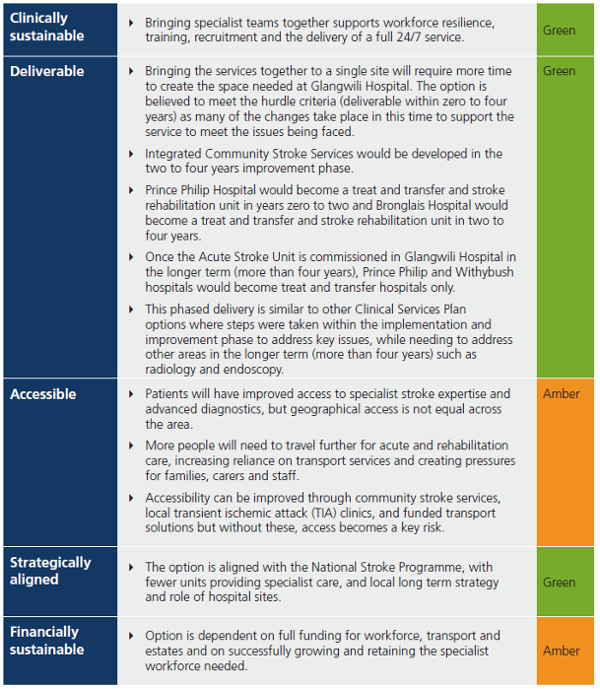 How we assessed the option - hurdle criteria
The option was scored in the same way as the options already considered by Board, using the same weighting for criteria and by the same Options Development Group. Due to differences in numbers of attendees, the scores below show the comparative score based on the maximum score that could have been awarded by both groups so that they can be easily compared.
The scores show what criteria needed to be met and the scores received for each of the options - the preferred option, option A, Option B, Option 106 and Option 210 and the criteria It needed to meet.
The number of patients likely to need transport between sites when unwell is 55% for the Preferred Option, compared to 52% for Option A, 46% for Option B, 54% for Option 106, and 50% for Option 210.
Compliance or attainment of standards is highest in the Preferred Option at 80%, followed by 62% for Option A, 60% for Option B, 51% for Option 106, and 46% for Option 210.
The impact on internal services (such as Emergency Departments) is 61% for the Preferred Option, compared to 56% for Option A, 45% for Option B, 52% for Option 106, and 51% for Option 210.
The impact on external services (such as Welsh Ambulance Services University NHS Trust) is 65% for the Preferred Option, compared to 44% for Option A, 39% for Option B, 53% for Option 106, and 52% for Option 210.
Clinical sustainability, based on patient demand for the service, is 72% for the Preferred Option, compared to 60% for Option A, 53% for Option B, 48% for Option 106, and 49% for Option 210.
Workforce sustainability over the next two to four years is 61% for the Preferred Option, compared to 48% for Option A, 37% for Option B, 46% for Option 106, and 39% for Option 210.
Financial sustainability, based on the cost difference between now and each option, is 49% for the Preferred Option, compared to 52% for Option A, 44% for Option B, 50% for Option 106, and 49% for Option 210.
Reduction in waiting lists across diagnostics, treatments, and surgery is 65% for the Preferred Option, compared to 56% for Option A, 52% for Option B, 55% for Option 106, and 57% for Option 210.
Patient travel time to sites is 59% for the Preferred Option, compared to 40% for Option A, 38% for Option B, 50% for Option 106, and 51% for Option 210.
Transfer travel time impact is 59% for the Preferred Option, compared to 50% for Option A, 41% for Option B, 50% for Option 106, and 52% for Option 210.
The impact on local communities when developing community sites is 65% for the Preferred Option, compared to 47% for Option A, 40% for Option B, 48% for Option 106, and 48% for Option 210.
The impact on staff and patients needing to travel for regional care is 66% for the Preferred Option, compared to 42% for Option A, 36% for Option B, 49% for Option 106, and 43% for Option 210.
The amount of activity taking place in a community setting is 60% for the Preferred Option, compared to 49% for Option A, 40% for Option B, 46% for Option 106, and 48% for Option 210.
The impact on population health outcomes is 70% for the Preferred Option, compared to 61% for Option A, 50% for Option B, 48% for Option 106, and 51% for Option 210.
Addressing barriers to care (such as transport and patient support) is 61% for both the Preferred Option and Option A, compared to 52% for Option B, 52% for Option 106, and 59% for Option 210.
Addressing barriers to equality is 62% for the Preferred Option, compared to 52% for Option A, 45% for Option B, 50% for Option 106, and 50% for Option 210.
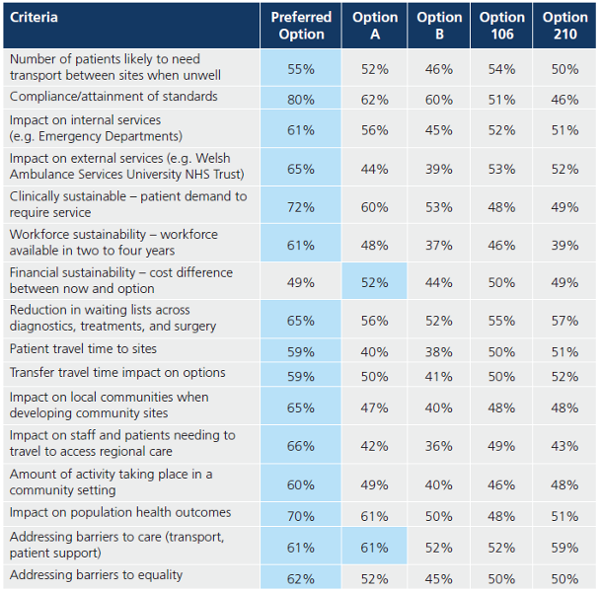 Scoring the options
The services have captured the following impacts in Equality Impact Assessments (EqIAs). As part of the second phase of the consultation, we would welcome any further comments linked to potential impacts of the preferred option:
Negative impacts:
- Some patients and their visitors may be negatively impacted by travel times and travel expenses as they may need to travel further to receive their care
- Some patients would be transported to the correct site by the Health Board. However, for return journeys home, or for visitors, there may be longer journeys and additional cost either by car or public transport
- Some staff may be required to travel further to work at alternative sites which may result in additional travel costs, childcare and carer needs
Positive impacts:
- Services provided across fewer sites bring different professionals together to work. This is a better use of resources and would improve service quality and continuity of care for patients
- Stroke is considered a specialism. The networked model being developed and proposed by the national programme means that the preferred option is aligned to what is going on nationally
- We should see reductions in a stroke patients’ length of hospital stay due to the access to diagnostics, medical and allied health professionals for more hours of the week A standalone acute stroke unit in Hywel Dda would improve staff recruitment and retention
- Ambulance teams will have access to prehospital video triage to support getting patients to right place, to receive the best care
- A stroke clinician will be available 24/7 to support teams at sites without a dedicated stroke unit for longer, helping them make the right treatment decisions for patients. This will attract greater opportunities for education and training
- Glangwili Hospital has the highest proportion and number of Welsh-speaking staff in the current stroke unit, who would be able to support Welsh-speaking patients and their families
We continue to consider ways to reduce risks or negative impacts on our communities. In this second phase of the consultation, we still want your views on how we can support people to better access stroke services if the preferred option is chosen. Below are some of the ideas we’ve heard so far:
- Improving transport links between hospital sites, exploring public/private partnerships, shuttle buses between sites etc
- Partnering with local transport companies to offer discount or travel vouchers for set journeys or time periods, as well as review supported travel/taxi costs
- Community and voluntary transport services available for patients that don’t meet the eligibility criteria, so they can receive non-emergency patient transport
- Some patients could be entitled to help with transport costs depending on their circumstances. Patient transport advice and information is available on our webpages, please search ‘patient transport’, or ask at each main hospital’s general office
- Assigning designated quiet rooms or zones, improving visitor spaces at hospitals, improving signage. Also ensuring public access areas are wheelchair friendly where possible to improve patient accessibility and comfort
- Directing staff to nearby childcare facilities, such as day care and creche services if affected by location changes
- Encouraging car sharing and sustainable transport where possible
Some people with a protected characteristic may be more disadvantaged or face more difficulties when trying to access healthcare services. The Equality Act 2010 protects people from being treated worse than other people because of:
- age
- disability
- gender reassignment
- marriage and civil partnership
- pregnancy and maternity
- race
- religion and belief (including no religious belief)
- sex
- sexual orientation
An equality impact assessment (EqIA) includes an overview of potential positive and negative impacts of change on people with protected characteristics. This also includes how we will mitigate them and address our equality duties.
In addition, the assessment considers the possible impacts people may experience due to being part of the Armed Forces community, their social and/or economic position and the Welsh language.
In our policies and how we work, we must:
- cut discrimination, harassment, victimisation, and other conduct that is prohibited by or under the Act
- advance equality of opportunity between people who share relevant protected characteristics and people who do not
- foster good relations between people who share relevant protected characteristics and those who do not
We also aim to:
- remove or minimise disadvantages suffered by people who share a relevant protected characteristic and are connected to that characteristic
- meet the needs of people who share a relevant protected characteristic that are different from the needs of those who do not share it
- encourage people who share a protected characteristic to take part in public life or in any other activity in which participation by such people is disproportionately low
- consider how we will tackle prejudice and understanding
We have produced impact assessments for the preferred option for stroke services across Hywel Dda.
These cover the proposed changes on:
- health
- equality
- environment and sustainability
- quality
- population health
You can read more in the full current version of the Equality Impact Assessment (EqIA) in the supporting documents area of our webpages. The assessments will be used to help our Board when making a final decision on how stroke services will be delivered in the future in Hywel Dda.
45 per cent of people in our Hywel Dda area speak Welsh. This is higher than the average number across Wales.
We know this is an issue that affects many patients across all our services and sites. We have an ongoing programme to support staff in using Welsh. We also know how important it is for patients to be able to communicate and that language ability may be impacted by a stroke.
We continue to make progress in complying with the statutory Welsh Language Standards. This means ensuring that all our communication, including digital, print, and signage, is bilingual (Welsh and English), and not treating Welsh less favourably than English.
We strive to promote a bilingual environment for everyone. We support our staff to learn and use Welsh in our workplaces and our communities. We’re also working to ensure people are offered services in Welsh without having to ask, as described in the Welsh Government’s ‘More Than Words’ plan.
We have a target to ensure that 50% of our workforce has a foundation level of Welsh by 2032. We report our progress through our Welsh Language Annual Report that can be found on our website. The full Equality Impact Assessment provides further details of how service changes could impact on the Welsh language, but we welcome any other comments and feedback.
We really want to hear from you. Information on how to get involved and share your views is available across our hospitals, community premises and through voluntary sector organisations. We will hold drop-in events, in person and online sessions, where you can come along, find out more information and let us know what you think.
Details of where and when you will be able to come and meet us can be found on our website here (opens in new tab) and on our social media channels.
We will also work closely with local media outlets, including radio and press organisations to raise awareness of this second phase of consultation.
Thank you for taking the time to share your views. Everyone’s input matters and will help shape the future of stroke services in our area. Please take time to read this document and tell us what you think by 26 July 2026. You can do this by:
- completing the questionnaire online here (opens in new tab). (you can request a copy by sending an email to us or calling us on the number below)
- posting it to: FREEPOST HYWEL DDA HEALTH BOARD (no stamp needed)
- emailing us: hyweldda.engagement@wales.nhs.uk
- speaking to us at one of our events (visit our website for an event near you or online), or phone us on 0300 303 8322 Option 5 (local call rates)
Anonymity and confidentiality of responses
Your responses to this survey are collected and analysed in a way that is intended to be anonymous. We do not ask for your name or contact details and survey findings will be reported in summary form only.
Please be aware that if you choose to include information about yourself in free text response fields, this information may make you identifiable, either directly or indirectly. We therefore encourage you not to include names, specific job titles, locations, or other details that could identify you or others, unless you are comfortable doing so.
Towards the end of the survey, we ask optional questions about characteristics such as age, sex, gender identity, disability, ethnicity, sexual orientation, religion or belief, marital or partnership status, armed forces status, caring responsibilities, language, household income, and part of your postcode. These questions are included to help us understand the diversity of experiences and ensure equality and fairness.
On their own, these questions do not identify you. However, in rare cases, a combination of answers may increase the risk that someone could be identified, particularly in smaller teams or population groups.
To protect your privacy, we apply appropriate safeguards, including aggregated reporting and suppression of small numbers, and your responses will not be used to make decisions about you as an individual.
Views provided by organisations or people acting in an official capacity may be published in full.
Our analysis and output report will be presented at a meeting of the Public Board and will be available on our website. This will be shared with Llais for their comments. Llais is the independent statutory body that gives the people of Wales more say in the planning and delivery of their health and social care services. The personal data you submit is processed by the Health Board as it is necessary for the performance of a task carried out in the public interest, namely consultation. This constitutes the lawful basis for processing under data protection legislation.
The Health Board will process any information you provide in response to this consultation in line with the current data protection regulations. The Health Board will hold any personal information provided for no more than one year after any decisions are finalised.
General themes raised by communities on the Health Board’s social media channels, but not personal information, will be collected so these can be included in the output report.
For our full privacy statement, please visit our website here (opens in new tab).
We know it is important to keep you updated, especially when you have taken the time to share your thoughts and views with us.
A report of what we heard during this second phase of the consultation will be published, fully considered, and discussed as part of a Health Board meeting later this year.
Health Board meetings are held in public. People are welcome to attend in person or to watch the meeting online. We will advertise this meeting on our website and social media pages. Details of our Board meetings can be found on our website here (opens in new tab).
Board members will consider all they have heard leading up to, and during, all phases of the consultation, including the equality impact assessments, supporting documents and data we have gathered and referred to in this document. They will also consider any new information that may come to light from the conversations with our communities.
We will publish the findings from this engagement period and the final consultation report for this phase of the Clinical Services Plan on our website. We will officially announce when this is available.
We will share these reports as widely as possible with people living in our area who have asked to be kept up-to-date on developments. We’ll also provide updates through key stakeholders, the local media, and social media.
If you wish to receive these updates, please join our involvement and engagement scheme Siarad Iechyd / Talking Health here (opens in new tab). or by:
- emailing: hyweldda.engagement@wales.nhs.uk
- phoning: 0300 303 8322 (option 5) local call rates
- writing to us at: FREEPOST HYWEL DDA HEALTH BOARD