How we assessed the preferred option - hurdle criteria
Hurdle criteria are what we use to assess the suitability of options when a service needs to change, as included in our Clinical Services Plan.
Here we describe how the option was appraised by the service.
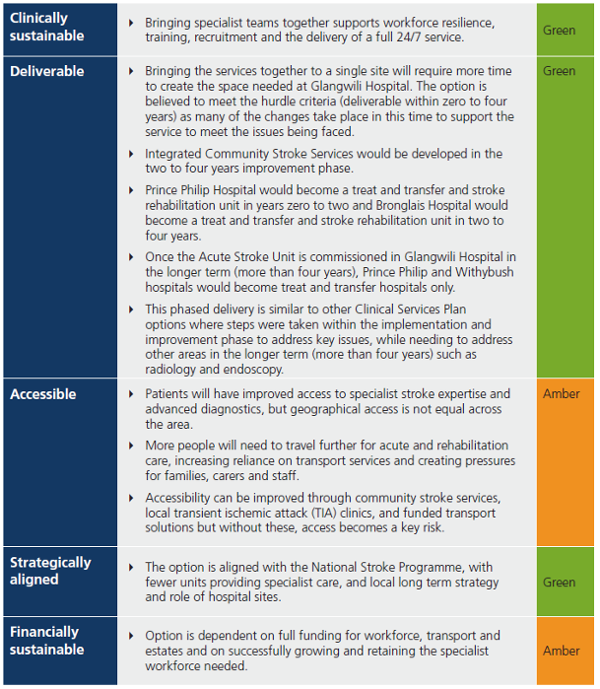
The preferred option is assessed under five categories: clinically sustainable, deliverable, accessible, strategically aligned, and financially sustainable. The risk levels are identified in colour – green for low risk, amber for medium risk and red for high risk.
Clinical sustainability for the preferred option is rated green (low risk). This is because bringing specialist teams together supports workforce resilience, training, recruitment and the delivery of a 24/7 service.
Deliverable for the preferred option is also rated green (low risk), this is because:
- Bringing the services together to a single site will require more time to create the space needed at Glangwili Hospital. The option is believed to meet the hurdle criteria (deliverable within 0 to four years) as many of the changes take place in this time to support the service to meet the issues being faced.
- Integrated Community Stroke Services would be developed in the two to four years improvement phase.
- Prince Philip Hospital would become a treat and transfer and stroke rehabilitation unit in years 0 to two and Bronglais Hospital would become a treat and transfer and stroke rehabilitation unit in two to four years.
- Once the Acute Stroke Unit is commissioned in Glangwili Hospital in the longer term (more than four years), Prince Philip and Withybush hospitals would become treat and transfer hospitals only.
- This phased delivery is similar to other Clinical Services Plan options where steps were taken within the implementation and improvement phase to address key issues, while needing to address other areas in the longer term (more than four years) such as Radiology and Endoscopy.
Accessibility for the preferred option is rated amber (medium risk). This is because:
- Patients will have improved access to specialist stroke expertise and advanced diagnostics, but geographical access is not equal across the area.
- More people will need to travel further for acute and rehabilitation care, increasing reliance on transport services and creating pressures for families, carers and staff.
- Accessibility can be improved through community stroke services, local transient ischemic attack (TIA) clinics, and funded transport solutions but without these, access becomes a key risk.
- Financial sustainability is rated amber (medium risk). This is because the preferred option is dependent on full funding for workforce, transport and estates, and on successfully growing and retaining the specialist workforce needed.
Strategically aligned for the preferred option is rated green (low risk). This is because the option is aligned with the National Stroke Programme, with fewer units providing specialist care, local long-term strategy and the role of hospital sites.
Financial sustainability is rated amber (medium risk). This is because the preferred option is dependent on full funding for workforce, transport and estates, and on successfully growing and retaining the specialist workforce needed.
 How we assessed the option - hurdle criteria